
5 May 2026
A Five-Minute Guide to the Hunter Valley’s Best Small Producers
Beyond the buses and the big names, a quieter conversation is happening — and the glasses are considerably more interesting.
The Hunter Valley occupies a peculiar place in the Australian wine consciousness. Its Semillon is one of the great white wines of the world — underestimated precisely because it requires patience most drinkers haven’t been asked to exercise. Its Shiraz, a plush, perfumed thing with none of the brooding weight of Barossa, is a study in cool restraint from a warm climate. And yet for years, the region’s story has been told by its largest producers, its concert venues, its coach tours. That story is incomplete. Spend a morning with the valley’s smaller makers and you begin to understand what this place is quietly becoming: a destination for drinkers who want wine with a face behind it.
Charteris Wines
Hunter Valley & Central Otago — a rare dual-hemisphere perspective
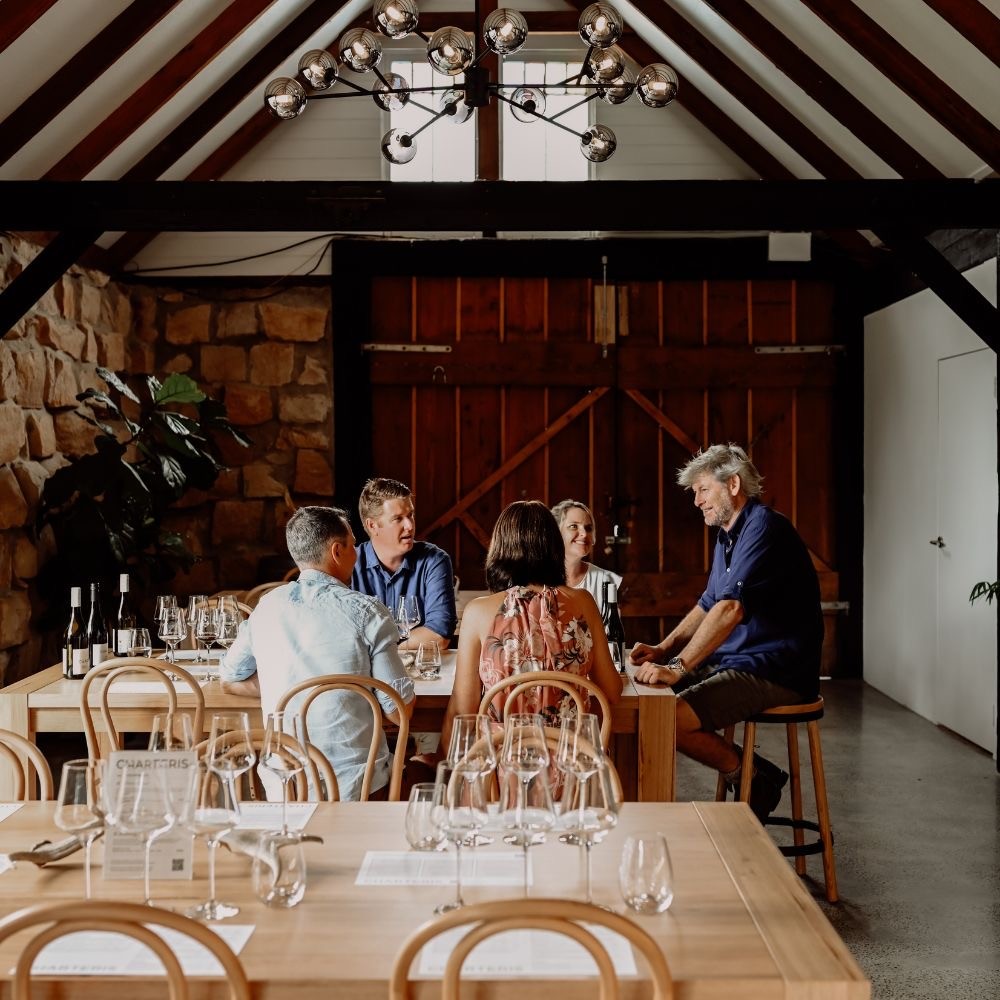
PJ Charteris is the sort of winemaker whose biography reads like a dare. Having built a significant reputation in Central Otago — one of New Zealand’s most demanding and rewarding wine regions — he turned his attention back to the Hunter Valley, the place where Australian wine began, and opened a cellar door that is unlike anything else in the region. What you encounter here is not a tasting room so much as a conversation: about place, about philosophy, about the radical differences between Otago Pinot Noir and Hunter Shiraz, between the cool drama of the South Island and the hazy warmth of the New South Wales hinterland.
The experience is deeply personal, shaped by PJ and co-owner Chrissi in a way that larger operations simply cannot replicate. There is no script here. The wines move between hemispheres and you move with them, your palate recalibrating with each pour. For anyone with a serious interest in terroir — in what latitude, altitude, and rainfall actually do to a grape — this is an essential stop. For anyone else, it is still one of the most enjoyable hours you’ll spend in the valley.
What to look for
Hunter Semillon for the cellar, and whichever Central Otago bottling PJ is pouring that day. Ask him about the differences between the two climates — the answer is worth the drive alone.
M&J Becker Wines
Dry-grown, minimal intervention, organically certified — and unexpectedly Californian
James and Meagan Becker represent a philosophy that remains genuinely unusual in the Hunter: restraint. Their small Pokolbin plot is undergoing organic certification, cropped at levels that would make the larger producers wince, and farmed with a conviction that the vineyard, not the winery, is where quality is determined. The Chardonnay — bright, nectarine-scented, with a creamy depth that doesn’t tip into heaviness — has quietly attracted some of the best notices in the region. The Syrah is Hunter in character but cooler in temperament than the valley’s more muscular examples.
The Californian angle is not a novelty; it reflects a genuinely cross-continental sensibility and makes for a tasting flight that raises interesting questions about site and style. Young Gun of Wine featured them for good reason.
What to look for
The Chardonnay, without hesitation. And ask whether the Syrah is ready — when it is, it rewards attention.
“Spend a morning with the valley’s smaller makers and you understand what this place is quietly becoming: a destination for drinkers who want wine with a face behind it.”
Thomas Allen Wines
Moon Mountain Vineyard, Broke Road — old vines, older friendships, wines without compromise
The term “old vine” is deployed with such reckless generosity in Australian wine that it has nearly lost its meaning. At Thomas Allen, it means something. The Moon Mountain Vineyard was planted in 1969, dry-farmed to concentrate rather than dilute, and sits at an elevation and aspect that the valley’s founding viticulturists understood instinctively. Craig and Steve — two winemakers whose collaboration predates Thomas Allen by decades — acquired the site in 2009 and have treated it with the seriousness it deserves.
The cellar door has become something of an institution: log fire, personal service, stories told by people who were actually there. The Alasdair Shiraz — named for a friend, carried across vintages with care — is the wine to seek out. It tastes like it was made for someone, not for a market.
What to look for
Alasdair Shiraz, and whichever vintage Craig and Steve are most animated about. Their enthusiasm is usually a reliable guide to what’s drinking best.
Mercer Wines
Sustainable, varietal adventurism, improbably priced — 13 trophies and counting
Aaron Mercer came up the Hunter way — scrubbing tanks, learning from the old guard — and then left to absorb as much of the wine world as he could: France, Germany, Canada, California. He returned with an appetite for varieties the Hunter has historically ignored, and a particular gift for organic and preservative-free winemaking. The range is genuinely eclectic: Montepulciano, Picpoul, Vermentino, Barbera, alongside the regional classics. His Barbera recently took the trophy for Best Italian Variety at the Winewise Championship. It costs thirty-two dollars.
The new cellar door on Hermitage Road, opened with wife and co-founder Alison in 2024, is exactly what a modern Hunter tasting experience should look like — informed, unpretentious, and family-friendly without being dumbed down. The preservative-free wines are worth trying even if you have no particular sensitivity to sulphites; they drink with an uncommon freshness.
What to look for
The Barbera and any of the Italian varietals. Then benchmark them against the Semillon — the contrast tells you everything about what Aaron Mercer is trying to do.
Vinden Wines
138 Gillards Road — second generation, experimentally minded, consistently excellent
Angus Vinden took stewardship of his family’s estate in 2015 and has since become one of the more compelling arguments for what the Hunter can produce when a maker refuses to be defined by its commercial consensus. Under the Vinden label he makes Semillon and Shiraz of genuine quality and regional character; under The Vinden Headcase, he is clearly enjoying himself — amphorae, whole-bunch fermentation, concrete, extended macerations, varieties that the Hunter has never particularly prioritised. Ned Goodwin MW, not given to casual praise, called his Tempranillos possibly the finest in the country.
The estate has two exceptional vineyard sites: the home block on heavy red clay, planted in 1995, and the historic Somerset Vineyard — originally established in 1891, replanted in 1965 — where old vines of Shiraz, Semillon, Tempranillo, and Chenin Blanc produce fruit of remarkable concentration. The Headcase label also carries a running self-portrait photography project that will, across the decades, document Angus ageing alongside his wines. It is either very ambitious or very vain, and either way, quite wonderful.
What to look for
The Somerset Vineyard single-barrel Shiraz if available. Then ask to taste whatever Headcase release is current — and enjoy the explanation that comes with it.
Comyns & Co
Centrally located, experienced hands, entirely without pretension
Not every great cellar door visit needs to be a seminar. Scotty Comyns is an experienced winemaker who, alongside his wife Missy, has created a space that prioritises pleasure over performance. The wines are contemporary in style, the setting is welcoming and well-positioned, and the atmosphere is one of relaxed enjoyment rather than competitive swirling. In a valley that can sometimes take itself rather seriously, Comyns & Co offers the very useful reminder that wine is, above all, supposed to be enjoyable.
What to look for
Whatever is poured with the most evident enthusiasm. At Comyns & Co, the best guide is the mood of the room.
A note on sequencing: if you are planning a day around this list, begin at Charteris for orientation — the trans-Tasman perspective resets your palate expectations usefully — then work outward. Vinden and Becker reward more focused attention and are best visited when you have time to linger. Thomas Allen is ideal in the late afternoon, when the light is good and the log fire earns its keep. Mercer and Comyns make excellent bookends for a group with varying levels of wine seriousness. The Hunter, it turns out, is generous enough for all of them.